How Do Noise Cancelling Headphones Work Physics: Explained

For people in the United States, noise-canceling headphones are common on airplanes, trains, buses, college campuses, and busy office floors. They seem to make outside sound disappear, but they do not create silence by blocking every sound. Instead, active noise cancellation uses microphones, a computer chip, and small speakers to reduce selected sounds through physics.
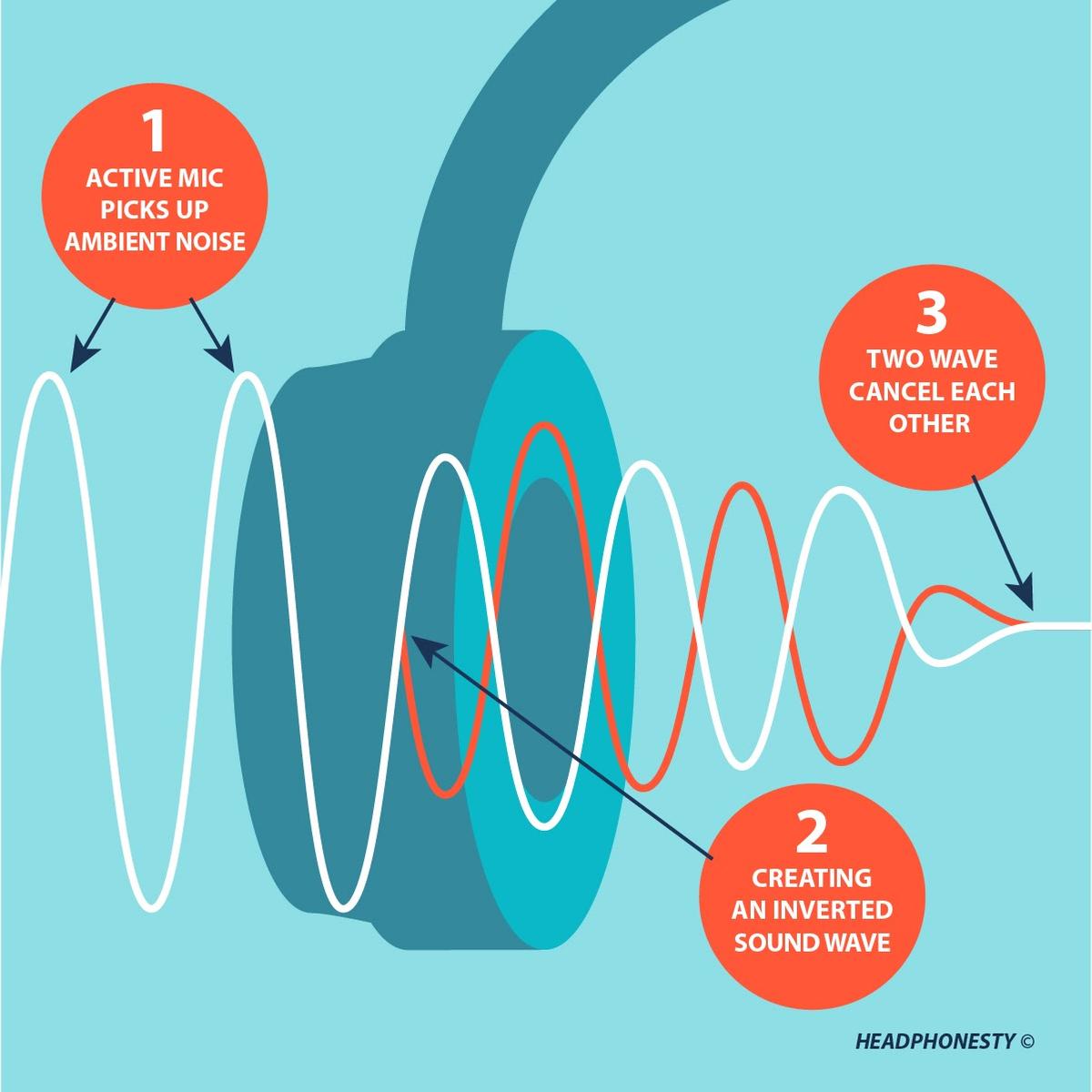
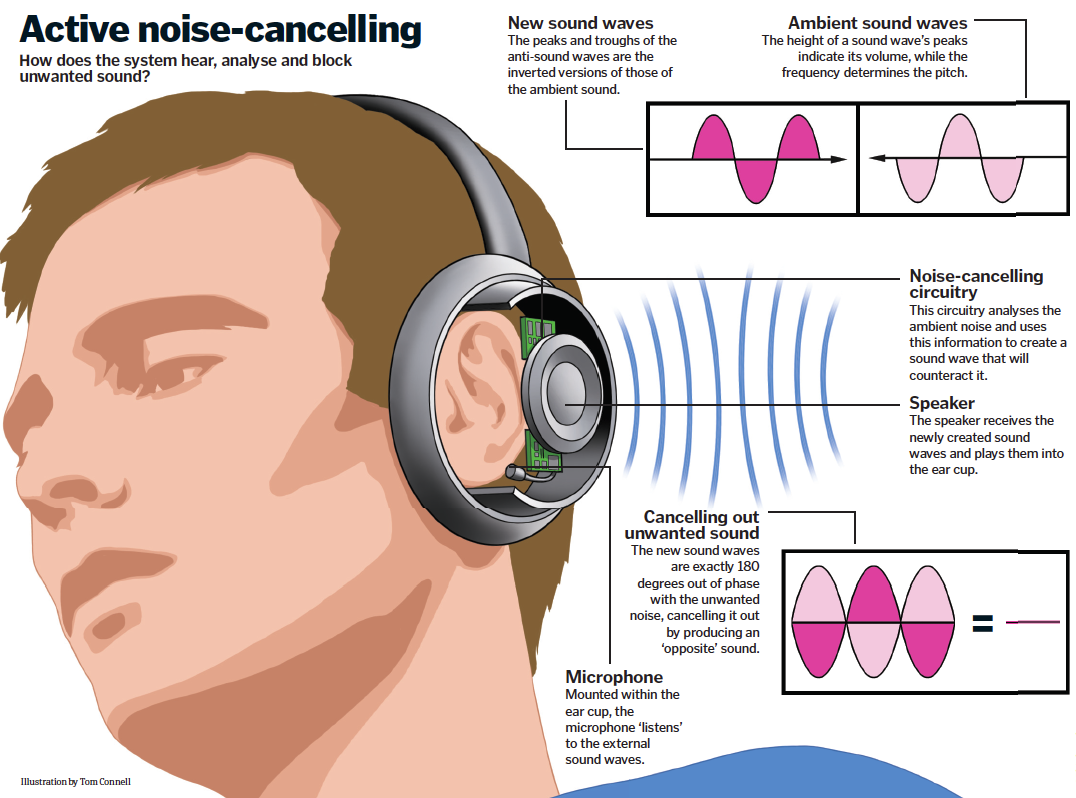
Noise-canceling headphones work by producing a second sound wave that is similar to unwanted noise but opposite in phase. When the two waves meet, they partly cancel through destructive interference. The headphones also use ear-cup materials and a tight fit to block sound passively.
The short answer: noise cancellation uses destructive interference
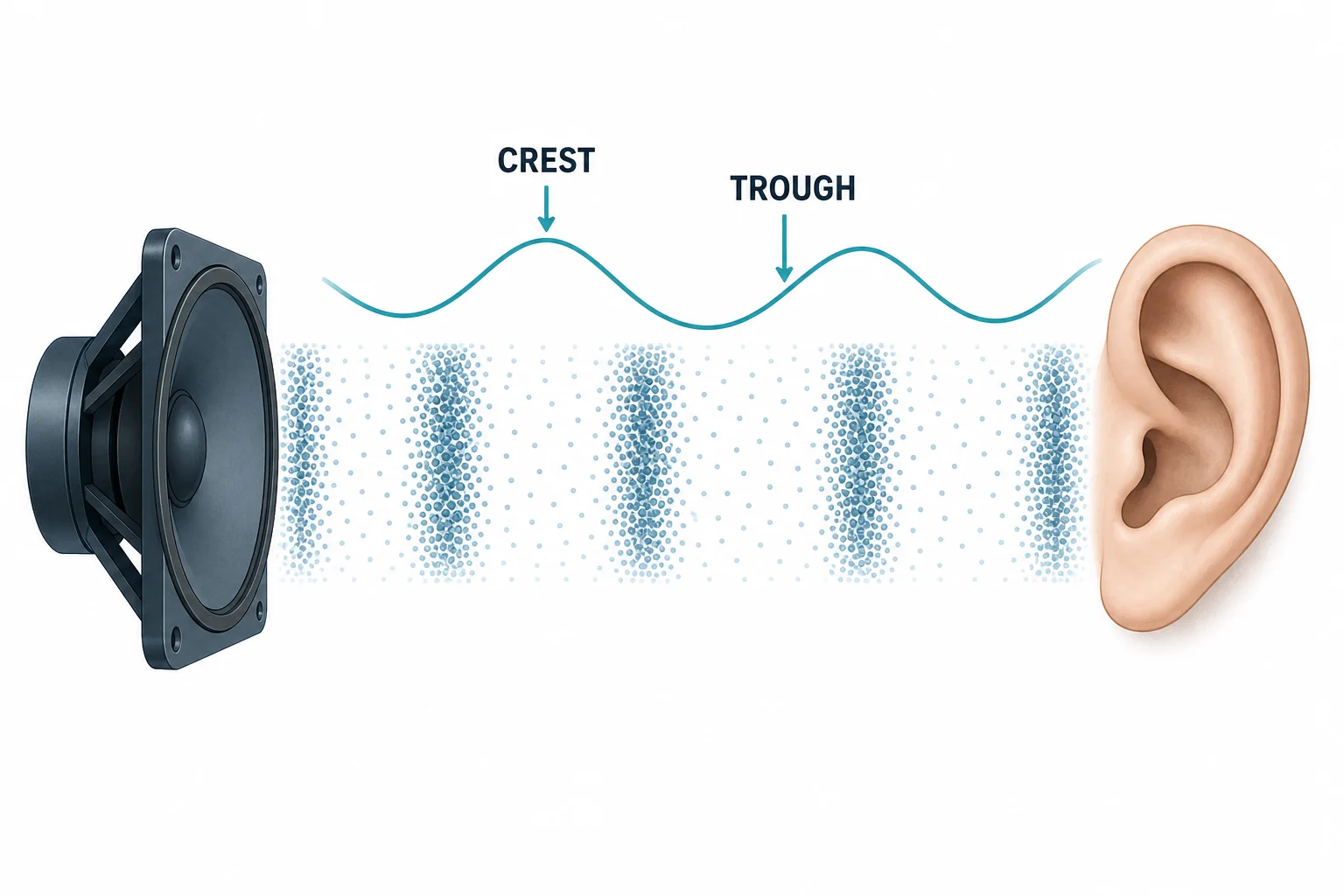
Sound is a pressure wave that travels through air. A speaker creates changes in air pressure, and your eardrum detects those changes. Your brain then interprets the pattern as sound.
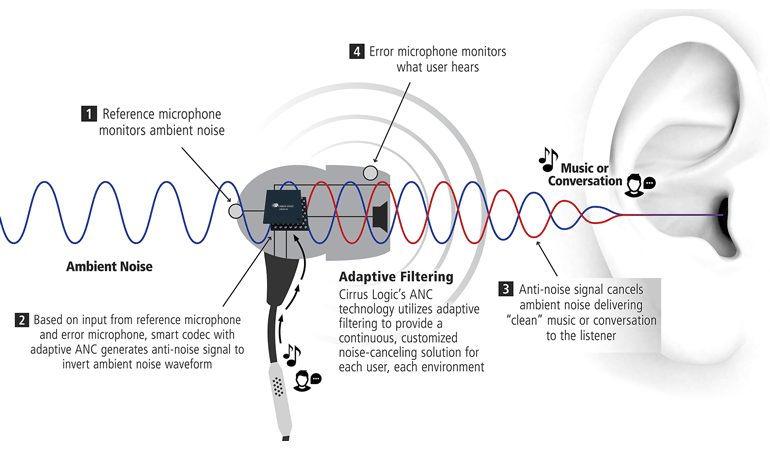
Active noise-canceling headphones, often called ANC headphones, measure unwanted sound with microphones. Their internal processor studies that sound and tells the headphone speakers to create an opposing wave.
A simple version looks like this:
[
p_{\text{total}}(t)=p_{\text{noise}}(t)+p_{\text{anti-noise}}(t)
]
If the anti-noise has nearly the same strength as the unwanted sound but the opposite phase, the total pressure becomes smaller:
[
A + (-A) \approx 0
]
Here:
- (A) is the pressure amplitude of the unwanted sound.
- (-A) is the opposing sound wave.
- The result is reduced sound pressure at the ear.
This process is called destructive interference. It does not mean the headphone speaker stops the original sound. The two sound waves overlap, and their pressure changes reduce each other at a particular place and time.
The cancellation works best when the headphones can predict the noise. Low, steady sounds such as airplane engine rumble, bus vibration, and air-conditioner hum are easier to reduce than sudden speech, clapping, or a barking dog.

What parts make active noise cancellation work?
An ANC headphone system normally includes microphones, a digital signal processor, speakers, and a battery. The ear cups and ear tips also play a major role.
Microphones detect outside or inside sound
ANC headphones use one or more tiny microphones to measure sound.
There are three common microphone layouts:
- Feedforward ANC: A microphone sits on the outside of the ear cup and hears noise before it reaches the ear.
- Feedback ANC: A microphone sits inside the ear cup and measures the sound near the listener’s ear.
- Hybrid ANC: The design uses both outside and inside microphones.
A feedforward microphone can react to noise before it reaches the ear. However, it may be affected by wind and may not know exactly what sound reaches the listener.
A feedback microphone measures the result inside the ear cup. This can help correct errors caused by fit, leakage, or changes in the sound field. However, the system must remain stable and avoid creating unwanted feedback.
Hybrid systems combine both approaches. The exact design varies by headphone model.
A processor calculates the anti-noise signal
The headphones send microphone data to a digital signal processor, or DSP. The DSP estimates the unwanted sound and creates a correction signal.
The processor must account for:
- The noise’s frequency
- The noise’s volume
- The time delay in the electronics
– The distance from the microphone to the ear - The speaker’s response
- The shape and seal of the ear cup
The timing must be very precise. Sound travels about 1,125 feet per second in air at room temperature. A delay of only a small fraction of a millisecond can affect whether two waves reduce or reinforce one another.
Small speakers play the opposing wave
The same drivers that play music also produce the anti-noise signal. The speaker does not play a simple reversed recording in every situation. Instead, the DSP adjusts the signal for the headphones’ design and the listener’s ear.
If the system creates the wrong level or timing, cancellation becomes weaker. In some cases, the result can be more noise at certain frequencies.
The battery powers the system
Active cancellation requires energy for the microphones, processor, and signal circuits. If the battery runs out, some headphones continue to play music with passive isolation. Other models may limit playback or switch to a different mode.
The battery does not power the basic physics of sound. It powers the system that measures noise and generates the opposing signal.
How does destructive interference cancel sound?
To understand ANC, imagine two water waves moving across a pool. If a crest meets another crest, the waves become larger. If a crest meets a trough of equal size, they become smaller or may briefly flatten.
Sound waves behave in a similar way.
A basic sound wave can be represented as:
[
x(t)=A\sin(2\pi ft+\phi)
]
In this formula:
- (A) is amplitude, related to sound pressure.
- (f) is frequency.
- (t) is time.
- (\phi) is phase.
An ideal anti-noise wave has nearly the same amplitude and frequency but is shifted by 180 degrees:
[
x_{\text{anti}}(t)=A\sin(2\pi ft+\phi+\pi)
]
Because a phase shift of 180 degrees reverses the wave:
[
\sin(\theta+\pi)=-\sin(\theta)
]
The two signals can add to nearly zero.
Real headphones do not achieve perfect cancellation at every moment. The microphone, processor, speaker, ear cup, and ear canal all affect the result. The listener also moves, changes the fit, and hears many sound sources at once.
Why phase matters more than simple volume
Turning down a speaker does not cancel noise. The opposing signal must have the right relationship to the original wave.
For a steady tone, the system can estimate that relationship fairly well. For changing noise, the required correction also changes. The faster the sound changes, the less time the system has to measure and respond.
This is why ANC often performs well against a constant airplane drone but less well against a nearby person’s changing speech.
Why do noise-canceling headphones work best with low-frequency noise?
ANC is usually strongest at low and mid-low frequencies. These sounds have longer wavelengths and often change more slowly than high-frequency sounds.
The wavelength of a sound is:
[
\lambda=\frac{v}{f}
]
Where:
- (\lambda) is wavelength.
- (v) is the speed of sound.
- (f) is frequency.
At about 1,125 feet per second:
- A 100-hertz sound has a wavelength of about 11.25 feet.
- A 1,000-hertz sound has a wavelength of about 1.13 feet.
- A 10,000-hertz sound has a wavelength of about 1.35 inches.
Low-frequency noise is often steady and predictable. The headphone has more time to measure it and produce a matching anti-noise signal.
High-frequency sound has shorter wavelengths and can change quickly over small distances. A slight gap in the ear seal can also let high-frequency sound enter directly. These factors make high-frequency cancellation harder.
This does not mean ANC cannot reduce high frequencies. It can help, but passive isolation usually does more of the work at higher frequencies.

Active noise cancellation vs. passive noise isolation
Active noise cancellation and passive isolation are different systems that work together.
| Feature | Active noise cancellation | Passive noise isolation |
|---|---|---|
| Main method | Creates opposing sound | Blocks or absorbs sound |
| Best for | Steady, low-frequency noise | Higher-frequency noise and sudden sounds |
| Requires power | Usually yes | No |
| Main parts | Microphones, DSP, speakers | Ear cups, pads, ear tips, materials |
| Common weakness | Limited against fast, complex sounds | Less effective against deep low-frequency rumble |
Passive isolation comes from the physical structure of the headphones. Over-ear pads form a seal around the ear. In-ear tips fill part of the ear canal. Materials absorb some sound energy, while the seal reduces the path for outside sound.
A good seal is essential. Glasses, hair, loose pads, or an incorrect ear-tip size can create gaps. Those gaps may reduce isolation, especially at higher frequencies.
The best real-world performance often comes from both methods:
- The ear cup blocks part of the sound.
- The ANC system reduces remaining low-frequency noise.
- Music or speech masks some of the sound that remains.

Why can you still hear voices, alarms, and sudden sounds?
Noise cancellation has physical and practical limits. It does not remove every sound equally.
Speech changes too quickly
Human speech contains many frequencies and changes constantly. A processor can reduce some steady background components, but it cannot always create accurate anti-noise for every consonant, pause, and volume change.
Speech also reaches the ear through several paths. Some sound enters around the ear cup, through the head and body, or through gaps in the seal.
Sudden sounds arrive before the system can react
A hand clap, dropped object, or car horn may change faster than the system can measure and correct. The headphones may reduce part of the event, but they cannot reliably erase it.
Fit changes the acoustic result
ANC is designed around the expected relationship between the microphone, speaker, ear cup, and ear. If the headphones shift, that relationship changes.
Common causes include:
- A loose over-ear fit
- Small or poorly fitted ear tips
- Thick eyeglass frames
- Hair between the pad and skin
- An ear cup that does not fully surround the ear
- Wind striking an outside microphone
Wind can confuse the microphones
Wind creates pressure changes at the external microphones. The ANC system may interpret those changes as noise and produce an imperfect correction. Some headphones include wind-reduction processing, but no design eliminates this problem in every condition.
A simple physics example of ANC
Consider a hypothetical steady 100-hertz engine sound with a pressure amplitude of 1 unit at the listener’s ear.
If the headphones produce an anti-noise wave with:
- The same 100-hertz frequency
- The same 1-unit amplitude
- A 180-degree phase shift
Then the two waves add to approximately zero at that point:
[
1+(-1)=0
]
Now suppose the anti-noise amplitude is only 0.8 units:
[
1+(-0.8)=0.2
]
The sound is reduced, but not eliminated.
If the anti-noise is delayed and no longer 180 degrees out of phase, the result may be larger. For a phase difference of (\theta), the combined amplitude of two equal waves is:
[
A_{\text{total}}=2A\left|\cos\left(\frac{\theta}{2}\right)\right|
]
At a 180-degree difference, the ideal result is zero. At a 0-degree difference, the waves reinforce each other.
This calculation is simplified. Real headphones deal with multiple frequencies, reflections, changing fit, and different sound paths. Still, it shows why amplitude and timing both matter.
Does noise cancellation damage hearing?
ANC itself does not make sound safe or unsafe. Hearing risk depends mainly on sound level, exposure time, and the condition of the listener’s ears.
ANC may help some people listen at a lower volume because it reduces background noise. That can be useful on a plane or in a loud public space. It does not make loud music harmless.
The National Institute for Occupational Safety and Health and the National Institute on Deafness and Other Communication Disorders provide information about noise exposure and hearing loss.
Use reasonable volume levels, take listening breaks, and avoid relying on headphones as hearing protection unless the product is specifically rated and used for that purpose. ANC headphones are not automatically substitutes for certified hearing protectors in construction, industrial, shooting, or other high-noise settings.
Do not use strong noise cancellation when it prevents you from hearing safety announcements, traffic, alarms, or nearby hazards. Transparency or ambient mode may be safer in places where environmental awareness matters.

What are the main limits of noise-canceling headphones?
The main limit is that cancellation occurs at a particular acoustic location, not everywhere in the room. The headphones can reduce sound near the listener’s ear, but they do not silence the source for other people.
Other limits include:
- Multiple sound sources: Several changing sounds are harder to predict.
- Poor fit: Gaps reduce passive isolation and disrupt ANC performance.
- Low-frequency vibration: Some vibration travels through the body or headphone structure rather than only through the air.
- Electronic artifacts: Poor tuning can create hiss, pressure-like sensations, or changes in sound quality.
- Battery dependence: Active features need power.
- Feedback instability: An error in sensing or processing can create an unwanted tone or ringing.
- Ear pressure sensations: Some users describe a feeling of pressure, although the headphones do not create a vacuum. The sensation may come from reduced low-frequency sound, changes in expectation, or the sound profile.
If ANC causes pain, dizziness, persistent ringing, or a noticeable change in hearing, stop using the headphones and consider medical advice. A technical explanation cannot identify the cause of an individual symptom.

How to get better noise cancellation
You can improve performance without changing the physics of the headphones.
- Choose the correct ear-tip size. For in-ear models, the tip should seal without causing pain. Test more than one size if available.
- Adjust over-ear placement. The ear should sit fully inside the cushion, and the pad should touch the head all around.
- Keep the microphones clear. Do not cover microphone openings with clothing, stickers, or thick hair.
- Use the correct mode. ANC, transparency, and normal modes serve different purposes.
- Reduce wind exposure. A hood, wind screen, or sheltered position may help outdoors.
- Keep firmware current when appropriate. Updates may change processing, but check the manufacturer’s instructions before installing them.
- Lower music volume in quiet conditions. Strong ANC does not require loud playback.
- Replace worn pads or damaged tips. A degraded seal can reduce passive isolation and ANC performance.
A sign of good fit is a clear reduction in steady low-frequency noise without a large change in comfort. If the reduction changes sharply when you press or reposition the ear cup, the seal may be the main issue.

Key takeaways
- Noise-canceling headphones use microphones, a processor, and speakers to create anti-noise.
- The anti-noise is designed to reduce unwanted sound through destructive interference.
- ANC works best with steady, low-frequency noise such as engine and HVAC rumble.
- Passive isolation handles much of the higher-frequency sound.
- A good seal is as important as the electronic cancellation system.
- ANC reduces noise near the ears; it does not create perfect silence.
- Noise-canceling headphones are not automatically hearing protection.
- Use transparency mode when hearing alarms, traffic, or announcements is important.
Frequently asked questions
Do noise-canceling headphones block sound or cancel it?
They do both. The ear cups or ear tips provide passive isolation by blocking sound. The electronic ANC system creates anti-noise to reduce selected sound waves near the ears.
Can noise cancellation cancel voices?
It can reduce some voice sound, especially when the voice is distant or mixed with steady background noise. It usually cannot remove nearby, changing speech completely because speech contains many frequencies and changes quickly.
Why does ANC work well on airplanes?
Airplane cabins contain strong, fairly steady low-frequency engine and airflow noise. Those qualities make the sound easier for the microphones and processor to measure and reduce. Cabin announcements and nearby conversations remain more audible.
Is active noise cancellation the same as hearing protection?
No. ANC headphones may reduce the sound you hear, but they are not automatically certified hearing protectors. For hazardous noise, use hearing protection that is designed and labeled for that environment.
Why do noise-canceling headphones sometimes make a hissing sound?
The microphones, amplifier, processor, and speaker can produce a low electronic noise floor. Some ANC systems also create a faint hiss when their circuits are active. A sudden loud tone, crackle, or ringing may indicate a fault or a processing problem.
Do noise-canceling headphones use more battery?
Usually, yes. The microphones, DSP, and anti-noise speakers require power. Battery use varies by model, ANC strength, connection method, and other features.
Conclusion
Noise-canceling headphones work through a controlled form of destructive interference. Microphones measure unwanted sound, a processor calculates a correction, and the headphone speakers create an opposing wave near the ear.
The system is most effective against steady low-frequency noise. Ear cups and ear tips handle much of the remaining sound through passive isolation. Fit, timing, frequency, wind, and battery power all affect the result.
For the best outcome, use a secure fit, keep the listening level moderate, and switch to transparency mode when awareness of your surroundings matters.