How Many Decibels Do Noise Cancelling Headphones Block: Facts

Introduction
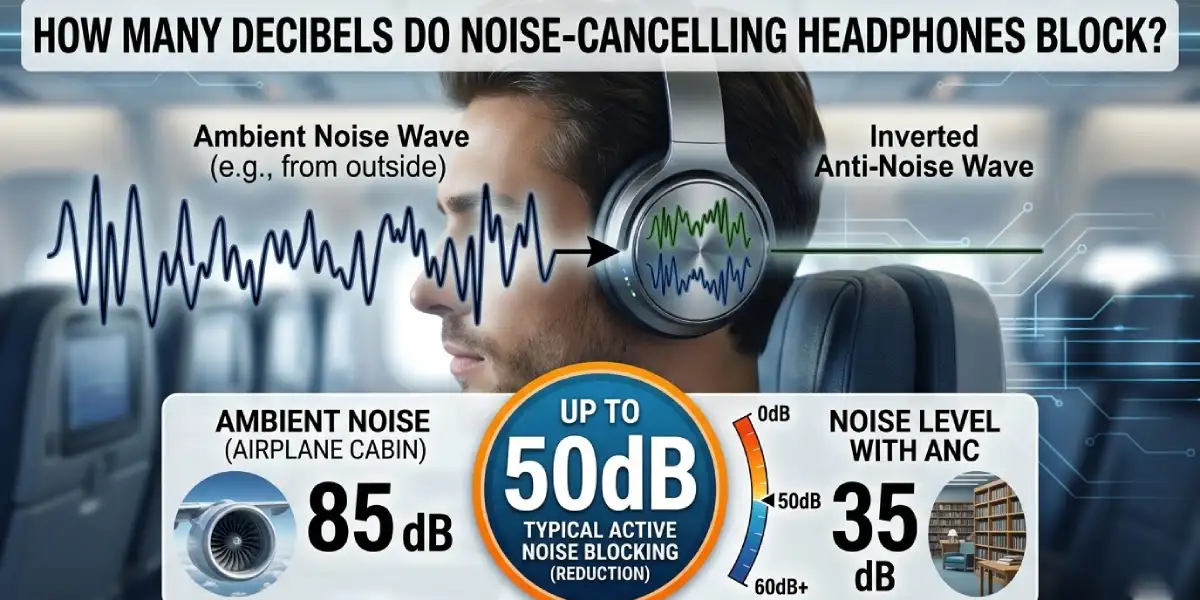
For people in the United States, noise-canceling headphones usually reduce steady, low-pitched noise by about 20 to 30 decibels (dB). Some premium models claim reductions near 40 dB or more, but the real result depends on the fit, ear seal, sound frequency, and test method.
Noise-canceling headphones do not create silence. They work best against sounds such as airplane engines, bus rumble, air conditioners, and office ventilation. They are less effective against voices, alarms, clapping, and other sudden or high-pitched sounds.
Quick answer: How many decibels can noise-canceling headphones block?
Most active noise-canceling headphones reduce unwanted sound by roughly 20–30 dB under favorable conditions. The strongest models may advertise higher figures, but those numbers may reflect a specific frequency, test setup, or maximum reduction rather than the average result across all sounds.
Here is a practical guide:
| Headphone type | Typical noise reduction | Best use |
|---|---|---|
| Open-back headphones | Little to none | Quiet rooms |
| Sealed headphones without ANC | About 5–20 dB | General background noise |
| Basic ANC headphones | About 10–20 dB | Office noise and light travel |
| Strong ANC headphones | About 20–30 dB | Aircraft and bus engine noise |
| Top advertised peak reduction | About 30–45 dB in some conditions | Specific low-frequency sounds |
These ranges are not guarantees. They are useful estimates, not universal product ratings.
A claimed 30 dB reduction means a sound is much lower at the ear. It does not mean the headphones block 30% of the sound. Decibels use a logarithmic scale, so a small number change can represent a large change in sound pressure.

What does “noise cancellation” mean?
Noise cancellation is a process that uses microphones, electronics, and speakers to reduce outside sound. The microphones listen to the surrounding noise. The headphones then create a second sound wave with the opposite phase.
When the two waves meet, they partly cancel each other. This process is called active noise cancellation, or ANC.
ANC works best when the sound is:
- Continuous
- Predictable
- Low in pitch
- Close to the microphones
- Reaching both ears in a similar way
That is why ANC often works well on an airplane. Engine noise is fairly steady and contains a large amount of low-frequency sound.
ANC is less reliable against:
- Human speech
- A ringing phone
- A siren
- A baby crying
- Hand claps
- Dishes breaking
- Sudden traffic sounds
- High-pitched mechanical noise
The headphones may reduce part of these sounds, but they usually cannot remove them fully.
Active noise cancellation versus passive isolation
Active noise cancellation uses electronics to reduce sound.
Passive noise isolation comes from the physical design of the headphones. Ear cups, ear pads, and in-ear tips create a barrier between your ears and the outside world.
A well-sealed pair of over-ear headphones may reduce some mid- and high-frequency sound without ANC. In-ear headphones can also perform well when their ear tips fit tightly. Poor fit, however, can sharply reduce both passive isolation and ANC performance.
The total reduction is a combination of both methods:
Total noise reduction = passive isolation + active cancellation
The two values should not be added as simple numbers in every situation. Sound reduction changes by frequency, and the same noise may pass through different parts of the headphone.

Why the decibel rating can be misleading
A single dB number cannot describe how headphones perform against every type of noise. Noise reduction is frequency-dependent, which means headphones may block bass sounds well but allow more midrange or treble sound through.
For example:
- A constant airplane rumble may be reduced by 25 dB.
- A nearby conversation may be reduced by only 5–15 dB.
- A sharp alarm may remain easy to hear.
- Wind may create noise that the ANC system cannot fully manage.
Manufacturers may also publish their highest measured reduction rather than an average across the full hearing range. A product that claims “up to 40 dB” may reach that result only at selected frequencies and under controlled conditions.
Decibels are logarithmic
The dB scale is logarithmic. A 10 dB change represents a tenfold change in sound intensity, although people often perceive it as roughly a change in loudness by about half or twice, depending on the sound.
Consider this simplified example:
- Outside noise: 80 dB
- Headphone reduction: 20 dB
- Approximate sound level at the ear: 60 dB
This calculation is useful for a basic estimate. Real listening conditions are more complex because sound can leak around the ear cups, pass through the headphone material, or enter through gaps in the seal.
A 30 dB reduction would reduce an 80 dB sound to about 50 dB in the same simplified example. That is a major reduction, but it does not guarantee that the listener will experience exactly 50 dB.
“Blocked” is not the same as “reduced”
Noise-canceling headphones usually reduce sound. They do not form a perfect acoustic barrier.
The word “block” is common in product descriptions, but it can create the wrong expectation. Even strong ANC headphones may leave some background sound, and the remaining sound can become more noticeable when the audio pauses.

How much noise do headphones block in common situations?
The answer changes with the sound source and the headphone design.
Airplane engines
Airplane engines produce steady, low-frequency noise. This is one of the best conditions for ANC.
Good noise-canceling headphones may reduce the engine rumble by around 20–30 dB, although the amount varies with the aircraft, seat location, seal, and headphone model.
The headphones may not remove all cabin sounds. Flight announcements, nearby conversations, and service-cart noise can still come through.
Office noise
ANC can reduce air conditioning, computer fans, and distant building noise. It may also soften general room noise.
Speech is harder to remove because voices contain a broad range of frequencies and change constantly. Passive isolation often helps more with voices than ANC alone, especially when the ear cups seal well.
Trains, buses, and subways
Vehicles create a mix of low-frequency vibration, wheel noise, brakes, announcements, and passenger sounds. ANC usually performs well against the steady engine and track rumble.
It will not reliably eliminate announcements or sudden braking sounds. Keep enough awareness for travel safety, especially near crossings, platforms, and traffic.
Construction noise
ANC may reduce some low-frequency machinery noise. It is not a substitute for hearing protection around loud construction equipment.
Impact tools, saws, alarms, and sudden bangs can remain dangerous even when they sound quieter. Use hearing protection selected for the work and follow the site’s safety rules.
Conversations
Noise-canceling headphones may reduce a conversation, but they rarely erase it. A strong seal can help, yet speech often remains understandable.
If you need to focus in a busy space, combine ANC with suitable audio at a safe level. Do not raise the volume until outside speech disappears.
Wind
Wind can be difficult for ANC microphones. Air movement may create rumble or turbulence that the system cannot cancel well. Some headphones offer wind-reduction modes, but results vary.
What affects noise-canceling performance?
The listed dB figure is only one part of the result. These factors can matter just as much.
Ear-cup seal
A small gap between the ear pad and your head can let outside sound in. Glasses, hair, hats, earrings, and thick hairstyles may weaken the seal.
Over-ear headphones work best when the ear cups fully surround the ears. In-ear models depend on the correct tip size and insertion.
Headphone fit
A loose fit can reduce isolation. A very tight fit may become uncomfortable and cause pressure around the ears.
For over-ear headphones, adjust the headband so the ear cups sit evenly. For in-ear headphones, try different tip sizes and check whether the tips stay sealed when you move.
Sound frequency
ANC is strongest at low frequencies. Passive materials often help more with higher frequencies.
This means one pair of headphones can perform very differently against:
- An airplane engine
- A nearby person speaking
- A smoke alarm
- A leaf blower
- A keyboard
- A subway train
Battery level
Many ANC headphones need power for their active cancellation system. Some models continue playing with ANC disabled when the battery is empty, while others may have limited functions.
Check the manufacturer’s manual for battery behavior. Do not assume that a dead battery provides the same protection as active ANC.
ANC mode and app settings
Some headphones include several modes, such as:
- Full noise cancellation
- Transparency or ambient mode
- Adaptive cancellation
- Wind reduction
- Conversation mode
Adaptive modes can change the amount of cancellation as conditions change. Transparency mode intentionally allows outside sound through and should not be confused with noise blocking.
Music and other audio
Playing music adds another sound source. If the music is loud enough to cover outside noise, you may be relying on volume rather than cancellation.
That can increase hearing risk. The goal of ANC is to reduce background noise so you can listen at a lower level.
How to compare noise-canceling headphones fairly
Use the same conditions when comparing models. A product page’s maximum dB claim does not always predict which pair will work best for you.
Check the measurement method
Look for information about:
- The frequency range tested
- Whether the result is peak or average reduction
- Whether the test used ANC alone or ANC plus passive isolation
- The test equipment and conditions
- Whether the result came from a standard test
- The exact model and firmware version
Independent measurements are more useful when they describe the test method. Review data from sites such as RTINGS can help show performance across frequencies, but results still depend on fit and test equipment.
Compare frequency graphs when available
A frequency graph shows how much sound reduction occurs at different pitches. A line that shows strong reduction at 100 Hz may tell you more about airplane performance than a single “up to” number.
For ordinary buyers, the main question is not “Which headphone has the largest dB number?” It is:
Does this headphone reduce the type of noise I hear most often?
Test the fit
If possible, wear the headphones for several minutes. Check for gaps, pressure, and movement.
For earbuds, try all included ear-tip sizes. A larger tip is not always better. The best tip is the one that seals the ear canal without causing pain.
Can noise-canceling headphones protect your hearing?
Noise-canceling headphones are not automatically hearing protectors.
Consumer headphones may make a loud place feel quieter, but they are not necessarily tested, labeled, or approved for occupational hearing protection. Their ANC rating cannot be treated as a Noise Reduction Rating (NRR).
The U.S. Occupational Safety and Health Administration (OSHA) and the National Institute for Occupational Safety and Health (NIOSH) provide guidance for workplace noise exposure. When you work around loud tools, machinery, firearms, engines, or industrial equipment, use hearing protection designed and rated for that environment.
Examples may include:
- Earplugs
- Earmuffs
- Double hearing protection
- Communication headsets with a stated protection rating
Do not depend on ANC headphones for a shooting range, construction site, aircraft maintenance area, or other high-noise workplace unless the manufacturer clearly documents the required protection standard and the equipment is suitable for that use.
The NIOSH noise exposure guidance and OSHA occupational noise standards explain why exposure time and sound level both matter.
How loud should you listen with ANC headphones?
Use ANC to lower the need for high playback volume, not to justify loud listening.
The National Institute on Deafness and Other Communication Disorders recommends protecting hearing from loud sounds. A practical approach is to:
- Start with a low volume.
- Increase it only as much as needed.
- Take regular listening breaks.
- Avoid using high volume to overpower traffic or machinery.
- Use hearing protection in loud work or recreation settings.
- Pay attention to ringing, muffled hearing, or ear discomfort.
If you need to turn the volume up because the headphones do not reduce outside noise, the problem may be poor fit or weak isolation. Try adjusting the fit before raising the volume.
Persistent ringing, pain, muffled hearing, or trouble understanding speech should be discussed with a qualified hearing professional.
A simple way to estimate the result
You can make a rough estimate with this formula:
Estimated level at the ear = outside sound level − estimated reduction
Hypothetical example
Suppose a bus produces an estimated 75 dB of noise near your seat. Your headphones reduce that type of sound by about 20 dB.
75 dB − 20 dB = approximately 55 dB
This is only a guide. The true level may differ because:
- The sound changes over time.
- The headphones reduce some frequencies more than others.
- The ear cups may not seal fully.
- The measurement point may not match the eardrum.
- Your head and body affect the sound field.
- The manufacturer’s figure may use a different test method.
Do not use this calculation as a workplace safety assessment. Occupational exposure decisions require suitable measurement and appropriate hearing protection.
Common mistakes when judging ANC performance
Mistake 1: Treating the largest advertised number as the average
“Up to 40 dB” usually describes a maximum result under certain conditions. It does not mean every sound becomes 40 dB quieter.
Mistake 2: Expecting ANC to remove voices
ANC is strongest against steady low-frequency noise. Voices are variable and contain many frequencies.
Mistake 3: Ignoring the ear seal
A premium ANC system cannot fully overcome a large gap around the ear. Fit comes first.
Mistake 4: Using consumer headphones as safety equipment
Noise cancellation can improve comfort, but it does not automatically provide certified hearing protection.
Mistake 5: Increasing volume until the world disappears
This may expose your ears to unnecessary sound. If outside noise remains intrusive, improve the fit or use equipment designed for that environment.
Mistake 6: Confusing transparency mode with cancellation
Transparency mode uses microphones to bring outside sound into the headphones. It is useful for awareness, but it does not block noise.
Frequently asked questions
Do noise-canceling headphones block 40 dB?
Some models advertise reductions of 40 dB or more, usually as a peak result under specific conditions. Most users should not expect a uniform 40 dB reduction against every sound.
Is 30 dB of noise cancellation good?
Yes. A 30 dB reduction can make steady engine or HVAC noise much less noticeable. The result may be smaller for voices, alarms, wind, and sudden sounds.
Do earbuds cancel as much noise as over-ear headphones?
They can perform well, but results depend on the ear-tip seal. Over-ear headphones often provide more consistent passive isolation, while well-fitted earbuds may cancel low-frequency noise effectively.
Can ANC headphones block snoring?
They may reduce the low-frequency part of snoring, but they may not remove it. A good seal, a steady masking sound, or a combination of methods may work better. Do not use excessive volume while sleeping.
Are noise-canceling headphones safe for children?
ANC itself is not automatically unsafe, but volume and listening time matter. Use volume limits, supervise use, and avoid relying on consumer headphones in loud settings where certified hearing protection is needed.
Key takeaways
- Most noise-canceling headphones reduce steady low-frequency noise by about 20–30 dB.
- Some products advertise 40 dB or more, but that is often a peak result under specific test conditions.
- ANC works best against airplane, bus, train, and HVAC rumble.
- Voices, alarms, wind, and sudden sounds are harder to cancel.
- Fit and ear seal can matter as much as the ANC electronics.
- Consumer ANC headphones are not automatically hearing protection.
- Use the lower playback volume that lets you hear comfortably.
Conclusion
The practical answer to “how many decibels do noise-canceling headphones block?” is usually about 20 to 30 dB for steady low-frequency noise. A higher advertised figure may be real under a narrow test condition, but it should not be treated as an all-purpose result.
Choose headphones based on the noise you face, the quality of the seal, and independent frequency-based measurements when available. For loud workplaces, tools, firearms, or other hazardous settings, use hearing protection rated for that job rather than relying on consumer ANC.
Sources and research basis
- NIOSH: Noise and Hearing Loss Prevention
- OSHA: Occupational Noise Exposure
- NIDCD: Hearing Protectors
- RTINGS: Noise Isolation and Cancellation Testing
- OSHA: Hearing Conservation